Cost of Building a Greenhouse Farm in Nigeria
Introduction
One of the first questions every prospective greenhouse farmer asks is: “How much does it actually cost?” The honest answer is: it depends heavily on structure type, size, location, and the level of automation you want — but understanding the cost drivers helps you budget realistically before committing, rather than relying on a single generic figure that may have little relevance to your actual site and goals.
Greenhouse farming has grown in popularity across Nigeria because it allows farmers to produce high-value crops — tomatoes, peppers, cucumbers, and leafy greens among them — with more control over growing conditions, reduced pest pressure, and often significantly higher yields per square meter than open-field production. But that potential only materializes if the investment is planned properly from the outset.
Key Factors That Determine Cost
Greenhouse type. A basic wooden-frame, net/polythene-covered structure costs significantly less than a galvanized steel-frame greenhouse with polycarbonate or UV-stabilized plastic covering. Steel structures last longer and withstand Nigeria’s harsh sun, humidity, and wind better, but come at a higher upfront cost. Wooden frames may suit a smaller pilot project or a farmer testing greenhouse farming before committing to a larger commercial build, but they typically need more frequent maintenance and replacement.
Size. Cost is usually calculated per square meter, so a 500m² greenhouse for tomato or pepper production will cost proportionally less per unit than a small 100m² pilot structure, due to economies of scale — fixed costs like site preparation and water infrastructure get spread across a larger production area.
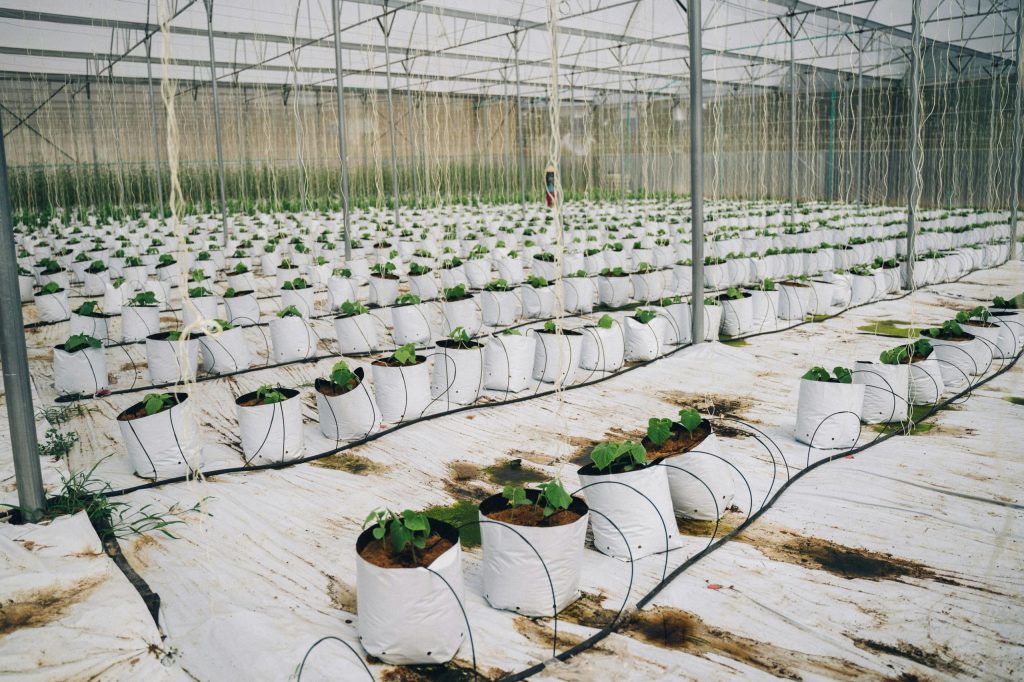
Irrigation system. A drip irrigation setup with fertigation capability adds cost but dramatically improves yield and reduces labor and water waste — often paying for itself within one or two seasons through improved crop consistency and reduced water bills or pumping costs.
Climate control. Ventilation fans, shade netting, and cooling pads increase cost but are often necessary in Nigeria’s hotter zones to keep crops from heat-stressing, particularly in the drier northern states or during the hottest months in the south.
Site preparation and location. Land leveling, fencing, water source development (borehole or reservoir), and distance from major towns (which affects material transport costs) all influence the final figure. A remote site far from urban supply centers will typically cost more to develop simply due to transport logistics for materials and labor.
Labor and installation. Skilled greenhouse installation labor is limited in some regions of Nigeria, and this affects pricing regionally — states with more established commercial farming activity often have more experienced installation crews available, while newer agricultural zones may require crews to travel, adding to cost.
A Realistic Cost Breakdown Framework
Rather than presenting a single number that varies wildly by region and specification, it’s more useful to understand greenhouse cost as a sum of distinct components:
- Structural frame and covering — typically the largest single line item, varying significantly between basic net-house and full steel-frame polycarbonate structures.
- Foundation and site preparation — clearing, leveling, and in some cases concrete footing or ground anchoring for the structure.
- Irrigation system — from basic gravity-fed drip kits to fully automated fertigation setups.
- Water source development — borehole drilling and pump installation if no existing reliable water source is available; this can be a major cost driver on sites without existing infrastructure.
- Climate control equipment — fans, cooling pads, and shade netting where the local climate demands it.
- Growing infrastructure — raised beds, growbags, or trellising systems depending on crop choice and cultivation method.
- Fencing and security — protecting the investment from theft and animal intrusion, an often-underestimated cost in rural sites.
- Labor and installation — both structural assembly and irrigation/equipment installation.
As a rough guide, low-tech net-house structures can start in the low range per square meter, while fully climate-controlled commercial greenhouses with automated irrigation sit considerably higher. Rather than rely on generic online estimates, it’s best to get a site-specific quotation, since soil condition, water access, and crop choice all shift the final number meaningfully.
Budgeting Mistakes to Avoid
Many first-time greenhouse investors underestimate the “invisible” costs that don’t show up in a basic structure quote — water source development, site access improvement, fencing, and ongoing operational costs like fertigation nutrients and energy for pumping. A structure quote alone can be misleading if it doesn’t include these supporting elements, leading to budget overruns partway through the project when these needs become apparent.
Another common mistake is choosing the cheapest structural option without considering total cost of ownership. A cheaper wooden or basic net-house structure may need significant repair or replacement within a few years, while a higher upfront investment in a galvanized steel structure can last considerably longer with proper maintenance — meaning the lower-cost option isn’t always the lower-cost choice over a multi-year horizon.
Financing and Phased Approaches
For farmers who can’t fund a full commercial greenhouse upfront, phased development is a practical alternative — starting with a smaller pilot greenhouse to prove the crop and market, then expanding as revenue allows. This approach requires the initial infrastructure (water source, access) to be planned with future expansion in mind, so that phase two doesn’t require redoing work already completed in phase one.
Some farmers also explore financing options through agricultural development banks, cooperative schemes, or private investment, particularly for larger commercial-scale projects. A detailed, professionally prepared cost breakdown and business plan significantly improves the chances of securing this kind of financing, since lenders and investors want to see realistic numbers rather than optimistic estimates.
Frequently Asked Questions
What size greenhouse is best for a first-time farmer in Nigeria? Many first-time greenhouse farmers start with a pilot structure in the range of a few hundred square meters — large enough to test crop performance and market demand, small enough to limit financial risk while learning the operational requirements of greenhouse farming.
Is drip irrigation worth the extra cost for a small greenhouse? In most cases, yes — the water savings, labor reduction, and yield consistency drip irrigation provides typically outweigh the additional upfront cost within one to two growing seasons, especially for water-sensitive crops like tomatoes and peppers.
How much does a borehole add to greenhouse project cost? Borehole cost varies significantly based on depth required (which depends on the local water table) and pump specifications, and can represent a substantial portion of total project cost on sites without existing water infrastructure — this is why site water assessment should happen early in project planning.
Can I build a greenhouse in phases to manage cost? Yes, provided the initial design accounts for future phases — particularly water and drainage infrastructure, which is far more expensive to retrofit than to plan for from the outset.
How to Get an Accurate Quote Rather Than a Rough Guess
Because greenhouse cost varies so much by site-specific factors, the most useful thing a prospective farmer can do before budgeting is gather the information a quote actually depends on: rough land dimensions and shape, whether there’s an existing water source or one needs to be developed, distance from the nearest major town or supply hub, and a general sense of intended crop and desired level of climate control. Bringing this information to an initial consultation — rather than simply asking “what does a greenhouse cost” in the abstract — lets a construction company give a far more useful, site-specific estimate rather than a generic range that may not reflect your actual situation at all.
It’s also worth requesting an itemized quote rather than a single lump-sum figure. An itemized breakdown lets you see exactly what’s included (and what isn’t), compare quotes from different providers on a like-for-like basis, and identify which specific items you might reasonably phase or adjust to fit your budget without compromising the parts of the project that matter most for crop performance.
Comparing Greenhouse Investment to Open-Field Farming Costs
Prospective greenhouse farmers sometimes weigh the greenhouse investment against the alternative of simply expanding open-field production instead. This comparison is worth making carefully rather than assuming greenhouse farming is automatically the better choice. Open-field farming has lower upfront infrastructure cost but carries ongoing exposure to pest pressure, unpredictable rainfall, and crop losses from weather events that greenhouse production largely avoids. Greenhouse farming requires more upfront capital but typically delivers more consistent yield, better crop quality, and the ability to extend production into periods (like the dry season) when open-field competitors can’t produce at all — often commanding better market prices as a result.
For farmers with access to reliable water and reasonable capital, greenhouse production frequently proves more profitable over a multi-year horizon despite the higher initial cost, but the payback period depends heavily on crop choice, market access, and how well the greenhouse is managed once built — infrastructure alone doesn’t guarantee returns without competent ongoing operation.
Ongoing Operating Costs Beyond the Initial Build
Budgeting for a greenhouse shouldn’t stop at construction cost — ongoing operating expenses meaningfully affect the overall economics of the investment. These typically include energy costs for pumping and any powered ventilation or cooling equipment, fertigation inputs (fertilizers and nutrients applied through the irrigation system), covering material replacement over time (plastic film typically needs replacement well before a steel frame does), labor for crop management, and routine maintenance of irrigation and climate control equipment. A complete financial picture — not just the upfront construction cost — gives a far more realistic view of what greenhouse farming actually requires to sustain profitably over time.
Getting Multiple Quotes Without Wasting Everyone’s Time
Getting more than one quote is sensible for a purchase this significant, but it’s worth doing efficiently — providing the same site information and specification to each prospective builder so the quotes can actually be compared on equal terms, rather than collecting several loosely defined estimates that each assumed different scope. A written brief covering your target size, general structure type preference (if you have one), crop plans, and any known site constraints (water source status, land dimensions) makes for a far more useful comparison exercise than verbal conversations that each contractor interprets slightly differently.
Conclusion
Irrigrow provides free site assessments and detailed cost breakdowns for prospective greenhouse farmers across Nigeria, helping you separate essential investment from optional upgrades based on your budget and crop plan. Understanding the real cost drivers — not just the headline structure price — is the difference between a greenhouse investment that performs as expected and one that runs into unplanned costs midway through.
Related services: See our full greenhouse construction company in Nigeria page, or read our guide on how to set up a greenhouse for tomato farming in Nigeria.
4. How to Set Up a Greenhouse for Tomato Farming in Nigeria
Meta description: Step-by-step guide to setting up a greenhouse for tomato farming in Nigeria — site selection, structure, irrigation, and crop management tips from Irrigrow’s agri-engineering team.
Introduction
Tomato farming is one of the most profitable greenhouse crops in Nigeria, largely because greenhouse cultivation protects plants from the pests, diseases, and erratic rainfall that devastate open-field tomato yields. Nigeria consumes enormous quantities of tomatoes across households, restaurants, and food processing, yet supply remains inconsistent — prices spike dramatically during off-season periods and when open-field crops fail due to pest outbreaks or excessive rain. This gap between demand and reliable supply is exactly what makes greenhouse tomato production an attractive opportunity for farmers willing to invest in proper infrastructure.
1. Choose and Prepare the Right Site
Look for flat, well-drained land with reliable access to water — either a borehole, well, or nearby water source. Avoid low-lying areas prone to flooding during the rainy season, since standing water around or under a greenhouse foundation creates root disease risk and structural problems over time. Soil testing beforehand helps determine whether you’ll grow directly in-ground or use raised beds and growbags — soil with poor drainage, high salinity, or a history of soil-borne tomato diseases (like bacterial wilt) often performs better with a soilless or raised-bed approach that avoids direct ground contact.
Site orientation also matters for greenhouse performance — proper positioning relative to prevailing wind direction affects natural ventilation efficiency, while orientation relative to the sun’s path affects internal temperature distribution throughout the day.
2. Select the Right Greenhouse Structure
For tomatoes, a naturally ventilated greenhouse with insect-proof netting and UV-stabilized plastic or polycarbonate covering works well across most of Nigeria’s agro-ecological zones. In hotter regions, shade netting or evaporative cooling pads help regulate internal temperature, since tomatoes are sensitive to excessive heat stress, which can cause flower drop and reduced fruit set even when other growing conditions are favorable.
Structural considerations for tomato greenhouses include adequate ridge height for proper hot air escape (tomatoes grown as tall indeterminate varieties benefit from taller structures that allow for trellising), sufficient vent area for airflow, and a covering material that balances light transmission (tomatoes need good light for fruit development) with UV protection for both the crop and the structure itself.
3. Install a Drip Irrigation and Fertigation System
Tomatoes are sensitive to inconsistent watering — both drought stress and waterlogging reduce yield and fruit quality, and inconsistent watering is a leading cause of blossom end rot, a common tomato disorder linked to irregular calcium uptake caused by fluctuating soil moisture. A drip irrigation system delivers water directly to the root zone, and when combined with a fertigation unit, allows precise nutrient dosing throughout the crop cycle — critical since tomatoes have different nutrient demands at different growth stages, requiring more nitrogen during vegetative growth and more potassium during fruiting.
4. Prepare Growing Beds or Containers
Depending on your setup, tomatoes can be grown in-ground with raised beds, in growbags, or in a soilless (hydroponic) system. Growbags and soilless systems reduce soil-borne disease risk considerably and allow for better control over the root zone environment, though they require more consistent irrigation management since the growing medium typically holds less water reserve than natural soil. Raised beds offer a middle-ground approach, improving drainage and reducing some soil-borne disease pressure while retaining some of the buffering capacity of a larger soil volume.
5. Select Suitable Tomato Varieties
Choose greenhouse-adapted, disease-resistant hybrid varieties suited to your target market — fresh market varieties are typically selected for appearance, shelf life, and eating quality, while processing varieties (destined for paste or sauce production) are selected more for yield and solid content. Disease resistance packages (resistance to common pathogens like Fusarium wilt, Verticillium wilt, and root-knot nematodes) are particularly valuable in Nigeria’s warm, humid growing conditions, which favor many of these pathogens.
6. Plan Pest and Disease Management
Even inside a greenhouse, whiteflies, aphids, and fungal diseases can occur — whiteflies in particular are a serious concern for tomato growers since they transmit viral diseases that can devastate a crop. Insect-proof netting at entry points and vents, plus a regular scouting routine to catch pest and disease issues early, minimizes chemical input needs and protects yield. Integrated pest management approaches — combining physical exclusion, biological controls where appropriate, and targeted chemical use only when necessary — tend to perform better long-term than relying solely on chemical spraying.
7. Train and Support the Crop
Tomatoes benefit from trellising or staking to keep fruit off the ground, improve airflow, and simplify harvesting. Indeterminate tomato varieties (which continue growing and producing over an extended period) particularly benefit from a proper trellising system, since they can grow quite tall and require support to prevent stems from breaking under fruit weight.
8. Manage the Growing Environment Day to Day
Beyond the initial setup, successful greenhouse tomato production requires ongoing environmental management — monitoring temperature and humidity, adjusting ventilation as external conditions change through the day and across seasons, and maintaining the irrigation schedule as the crop moves through different growth stages. Many first-time greenhouse farmers underestimate this operational commitment, treating the greenhouse as a “set and forget” investment rather than an actively managed production system.
9. Plan for Harvest and Post-Harvest Handling
Tomato quality can degrade quickly after harvest without proper handling — timely picking at the right ripeness stage for your market, careful handling to avoid bruising, and appropriate storage conditions all affect how much value you actually capture from your crop. For farmers selling to processors or supermarkets, meeting specific quality and consistency standards often matters as much as raw yield volume.
Realistic Yield and Return Expectations
With the right structure and irrigation setup, a well-managed 500m² greenhouse can produce significantly higher yields than an equivalent open-field plot, with better fruit quality and a longer harvest window — since greenhouse production reduces the crop losses from pests, disease, and weather that regularly affect open-field tomato farming in Nigeria. However, realistic yield expectations depend on variety choice, growing method, and the quality of day-to-day crop management, not just the infrastructure itself.
Frequently Asked Questions
How long does it take from planting to first harvest in a greenhouse? This varies by variety, but greenhouse tomatoes typically reach first harvest within roughly 10-12 weeks of transplanting, with continued harvest over an extended period for indeterminate varieties.
Can I grow tomatoes in a greenhouse without drip irrigation? It’s possible with manual watering, but drip irrigation significantly improves consistency, reduces labor, and lowers disease risk from wet foliage — making it a strong recommendation rather than a strict requirement for smaller pilot operations.
What’s the biggest mistake first-time greenhouse tomato farmers make? Underestimating the ongoing management commitment — ventilation, irrigation scheduling, and pest scouting all require regular, consistent attention, and greenhouses that are under-managed often underperform their potential despite good initial infrastructure investment.
Do I need soilless growing (hydroponics) for greenhouse tomatoes? No — many successful greenhouse tomato operations in Nigeria use in-ground or raised bed systems. Soilless growing offers advantages in disease control and precision but comes with a steeper learning curve and higher setup cost.
Understanding Nutrient Requirements Through the Growth Cycle
Tomatoes move through distinct nutritional phases, and understanding these helps get more value from a fertigation system rather than applying a single generic feed schedule throughout the crop cycle. During early vegetative growth, plants benefit from slightly higher nitrogen levels to support leaf and stem development. As plants move into flowering and fruit set, phosphorus and a more balanced nutrient profile support strong root development and flower formation. During active fruiting and harvest, potassium becomes increasingly important, supporting fruit development, size, and quality, while excessive nitrogen at this stage can actually push the plant toward more leaf growth at the expense of fruit production. A fertigation system with the flexibility to adjust nutrient ratios across these stages — rather than a fixed, unchanging feed — generally supports better overall yield and fruit quality.
Temperature and Humidity Management Specific to Tomatoes
Tomatoes have a fairly defined temperature range within which they perform best, and conditions outside that range measurably affect yield even when other factors (water, nutrients, pest control) are well managed. Excessive heat, common during Nigeria’s hottest months, can cause flowers to abort before fruit sets, directly reducing yield regardless of how healthy the plant otherwise looks. High humidity combined with poor airflow increases fungal disease pressure, a particular concern in Nigeria’s more humid regions. Practical management includes ensuring adequate ventilation capacity for your specific greenhouse and climate, using shade netting during the hottest periods if heat stress is a recurring issue, and, for more intensive operations, considering evaporative cooling where the investment is justified by crop value.
Common Problems Specific to Greenhouse Tomato Production and How to Address Them
Blossom drop without fruit set often traces back to temperature extremes (either too hot or occasionally too cold) or inconsistent watering affecting plant stress levels, rather than a pollination problem as is sometimes assumed. Blossom end rot — a dark, sunken patch on the bottom of developing fruit — is typically linked to inconsistent water availability affecting calcium uptake, even when soil calcium levels are technically adequate, which is why consistent drip irrigation matters so much for this crop specifically. Leaf curling can result from several causes including heat stress, water stress, or certain viral diseases transmitted by whiteflies, making accurate diagnosis important before assuming a single cause and applying the wrong corrective action.
Scaling From a Pilot Greenhouse to Commercial Tomato Production
Many successful commercial greenhouse tomato operations in Nigeria started as smaller pilot projects, allowing the farmer to learn the crop’s specific management requirements — irrigation scheduling, pest monitoring, harvest timing — before committing to a larger, more capital-intensive commercial-scale operation. This staged approach reduces financial risk while building the practical operational knowledge that greenhouse tomato farming genuinely requires, since much of what determines success comes down to consistent day-to-day management rather than the infrastructure alone.
Record-Keeping as a Management Tool
Keeping simple records of irrigation timing, fertigation dosing, pest observations, and yield per harvest gives a greenhouse tomato operation something most informal setups lack: an actual basis for improving decisions season over season, rather than relying purely on memory or instinct. Over a few growing cycles, these records start to reveal patterns — which irrigation schedule correlated with the best fruit set, which pest issues tend to recur at certain points in the season — that a farmer without this record can only guess at, making each new season an opportunity to genuinely improve on the last rather than simply repeat it.
Conclusion
With the right structure and irrigation setup, a well-managed greenhouse tomato operation can be one of the more reliable and profitable options in Nigerian greenhouse farming. Success depends on getting the fundamentals right from the start — site selection, structure design, irrigation, and variety choice — and then committing to the ongoing management that keeps the crop performing throughout its production cycle.
cost of building a greenhouse farm in Nigeria | cost of building a greenhouse farm in Nigeria | cost of building a greenhouse farm in Nigeria | cost of building a greenhouse farm in Nigeria