Drip Irrigation Kit Suppliers in Nigeria: A Complete Guide for Farmers and Agribusinesses
Nigeria’s agricultural sector is experiencing a growing need for reliable irrigation systems. With changing rainfall patterns, increasing demand for food, rising production costs, and the need for year-round farming, many farmers are looking for efficient ways to provide crops with the right amount of water at the right time. Among the different irrigation methods available today, drip irrigation has become one of the most practical solutions for farmers, commercial growers, greenhouse operators, landscapers, and agricultural investors.
For anyone searching for drip irrigation kit suppliers in Nigeria, choosing the right supplier is about much more than finding the cheapest kit. A reliable irrigation system must be properly designed for the farm, water source, soil, crop type, field size, pressure requirements, and expected production cycle. The quality of the drip tape, pipes, filters, connectors, valves, pumps, emitters, and other components can also determine whether an irrigation system performs effectively for several years or develops problems after only one farming season.
Irrigrow Civil & Engineering Ltd provides irrigation engineering solutions in Nigeria, including the design and installation of drip and sprinkler irrigation systems. The company combines irrigation expertise with broader civil engineering, water infrastructure, drainage, construction, and project consultancy capabilities.
This guide explains what farmers should know when looking for drip irrigation kit suppliers in Nigeria, the components of a drip irrigation system, the benefits of drip irrigation, factors affecting cost, how to select a supplier, and why professional system design and installation matter.
What Are Drip Irrigation Kits Used for in Nigeria?
A drip irrigation kit is a collection of components designed to deliver controlled quantities of water directly to the root zone of plants. Instead of distributing water over an entire field, the system uses pipes, tubes, and emitters or drip tape to apply water close to individual plants or crop rows.
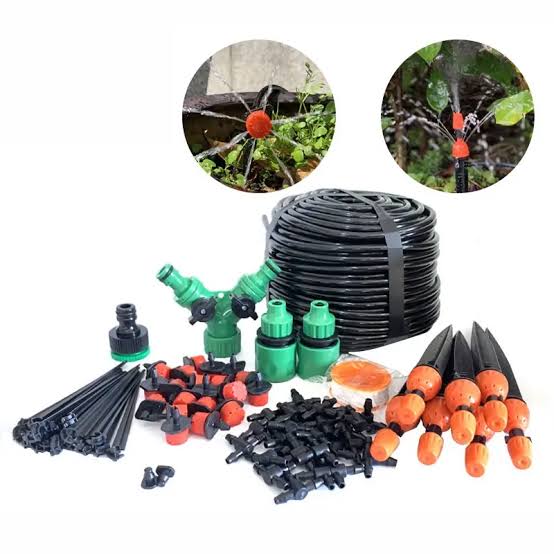
A typical drip irrigation system may contain a pump or water source connection, filtration unit, mainline, sub-mainlines, lateral pipes or drip tape, valves, connectors, end plugs, pressure regulators, emitters, and fertigation equipment. Depending on the project, a water storage tank, borehole, solar pumping system, fertilizer injector, pressure gauge, or automation system may also be required.
The basic principle is straightforward: water is taken from a source, filtered, pressurized where necessary, transported through the mainline and sub-mainlines, and then distributed through smaller lateral lines. Emitters release water slowly and consistently near the plants.
This approach allows farmers to control water application more accurately than many traditional irrigation methods.
Why Choose Drip Irrigation Systems for Nigerian Farms?
Water management is increasingly important for Nigerian agriculture. Farmers who depend entirely on rainfall may experience difficulties when rainfall starts late, stops early, becomes irregular, or does not provide sufficient moisture during critical stages of crop development.
Drip irrigation gives farmers greater control over their water supply. It can make it possible to continue production during dry periods, support off-season farming, and maintain more consistent soil moisture around crop roots.
Another important advantage is that drip irrigation can reduce unnecessary water application. Because water is delivered close to the plant rather than being sprayed across the entire field, the system can reduce losses associated with evaporation, runoff, and watering areas where crops are not growing.
Drip irrigation is particularly useful for vegetables, fruits, orchards, greenhouse crops, and other high-value agricultural production. Commercial systems can also incorporate fertigation, allowing soluble fertilizers to be introduced into irrigation water and distributed through the system.
Components of a Drip Irrigation Kit for Agricultural Projects
When comparing drip irrigation kit suppliers in Nigeria, it is important to understand exactly what is included in the quotation. A kit advertised as a “complete system” may not contain every component required for a particular farm.
1. Water Source
Every irrigation project begins with a reliable water source. Depending on the farm, this may be a borehole, river, stream, reservoir, well, dam, storage tank, or another approved water source.
The quantity and quality of available water should be assessed before purchasing a drip kit. A system designed for a small vegetable garden may not be suitable for a large commercial farm.
2. Pumping System
Where gravity cannot provide adequate pressure and flow, a pump may be required. The correct pump depends on factors such as water source, elevation, distance, pipe diameter, required flow rate, and system pressure.
For some off-grid agricultural projects, solar-powered pumping can be considered. In other situations, electric, petrol, or diesel pumping systems may be appropriate.
3. Filtration System
Filtration is one of the most important parts of a drip irrigation installation.
Small emitter openings can become blocked by sand, silt, algae, organic matter, or other particles in the water. A suitable filtration system helps protect the drip lines and maintain uniform water distribution.
Depending on water quality and system requirements, different filter types can be used. The appropriate filter should be selected after assessing the water source rather than simply purchasing the cheapest available option.
4. Mainline and Sub-Main Pipes
The mainline transports water from the pump or water source to the irrigation zones. Sub-mainlines then distribute water toward individual sections of the farm.
Pipe diameter should be properly calculated. If pipes are undersized, pressure losses can affect water distribution and system performance.
5. Drip Tape or Lateral Tubing
Drip tape is commonly used for row crops such as tomatoes, pepper, onions, cucumber, vegetables, and other crops planted at relatively regular spacing.
The selection of drip tape should consider wall thickness, emitter spacing, discharge rate, operating pressure, field length, crop spacing, and expected lifespan.
Cheap drip tape can appear attractive initially, but poor-quality materials may result in leakage, uneven discharge, frequent blockage, or premature replacement. Current Nigerian market listings show that drip tape and complete irrigation kits can vary substantially in price depending on specifications and quality.
6. Emitters or Drippers
Emitters regulate the amount of water released to the plant.
Different crops require different emitter arrangements. A vegetable crop planted in rows may require closely spaced outlets, while an orchard may use one or more emitters around individual trees.
Correct emitter selection helps ensure that water reaches the crop root zone without excessive application.
7. Valves and Connectors
Valves allow the operator to control different sections of the irrigation network. Connectors, take-offs, end plugs, elbows, tees, and other fittings allow the system to be assembled and maintained.
A professional supplier should ensure that fittings are compatible with the selected pipes and drip tape.
8. Fertigation Equipment
One of the major benefits of drip irrigation is the possibility of fertigation. A fertilizer injector, Venturi system, or fertilizer tank can introduce soluble nutrients into the irrigation water.
This can help place nutrients close to the root zone and reduce unnecessary fertilizer application. However, fertigation should be properly managed to prevent damage to crops and clogging of the irrigation system.
What Crops Can Use Drip Irrigation Kit?
Drip irrigation is suitable for a wide range of crops.
Vegetables
Tomatoes, peppers, cucumber, cabbage, onions, okra, spinach, pumpkin, leafy vegetables, and other vegetable crops can benefit from controlled irrigation.
Vegetable farmers are among the users who can gain significantly from drip systems because water requirements can be managed according to crop growth stages.
Fruits and Orchards
Drip irrigation can be used for mango, citrus, guava, cashew, banana, pineapple, watermelon, and other fruit crops.
For orchards, the system can be designed around individual trees rather than crop rows.
Greenhouse Farming
Greenhouses require controlled environmental conditions, and irrigation is an important part of greenhouse management. Drip irrigation can be integrated into greenhouse projects to deliver water and nutrients directly to plants.
Irrigrow Civil & Engineering Ltd also provides greenhouse construction and integrates drip irrigation into agricultural infrastructure projects.
Commercial and Estate Landscaping
Drip irrigation is not limited to farms. It can also be used for gardens, landscaped estates, hotels, institutional properties, commercial developments, and other green spaces.
This makes it useful for property developers and facility managers who need a reliable way to maintain plants while controlling water usage.
How Much Does a Drip Irrigation Kit Cost in Nigeria?
One of the most common questions from farmers searching for drip irrigation kit suppliers in Nigeria is: How much does a drip irrigation system cost?
There is no single price that applies to every farm.
The total cost depends on the size of the farm, crop type, water source, terrain, pipe layout, drip tape specification, filtration requirements, pumping requirements, storage capacity, automation, fertigation, installation, and other project-specific factors.
For example, current Nigerian market listings show complete kits and irrigation packages at substantially different prices. One listed one-acre kit was priced at ₦250,000, while another full irrigation kit was listed at ₦515,000. These figures demonstrate why farmers should not make decisions based solely on a headline price; the contents and specifications of each package need to be compared.
Irrigrow’s published guidance similarly notes that professionally installed drip irrigation can range from approximately ₦250,000 to more than ₦1,000,000 per acre depending on the project. Per-hectare systems can cost considerably more depending on water infrastructure, components, automation, and installation requirements.
Prices can also change because of exchange rates, import costs, transportation, material prices, and supplier availability. Therefore, farmers should request a project-specific quotation rather than relying on a generic online price.
Why the Cheapest Drip Irrigation Kit Suppliers in Nigeria May Not Be the Best Choice
Price is important to farmers, but it should not be the only consideration.
A very cheap kit may use low-quality tape, inadequate filtration, weak fittings, poorly sized pipes, or components that are unsuitable for the water pressure required by the farm.
A system can therefore be inexpensive to purchase but expensive to operate.
For example, if drip lines block frequently, the farmer may have to replace sections repeatedly. If fittings leak, water and pressure are lost. If the pump is incorrectly sized, it may not provide sufficient flow. If the filter is inadequate, emitters may clog.
A properly engineered system focuses on total value, including durability, water efficiency, maintenance requirements, crop performance, and expected operating life.
How to Choose Reliable Drip Irrigation Kit Suppliers in Nigeria
Choosing the right supplier can make a major difference to the success of an irrigation project.
Technical Knowledge
A good supplier should understand irrigation design rather than simply sell components.
They should be able to evaluate your farm and recommend appropriate pipe sizes, drip tape, emitter spacing, filters, pressure requirements, and pumping arrangements.
Site Assessment
The irrigation system should be designed around the actual site.
Important factors include:
- Farm size
- Land shape
- Soil characteristics
- Crop type
- Crop spacing
- Water source
- Water quality
- Elevation
- Distance between water source and field
- Required irrigation frequency
- Available electricity or alternative power
- Future expansion plans
A site assessment helps prevent the purchase of unsuitable equipment.
Quality Components
Ask the supplier about the specifications and expected lifespan of the components.
Important questions include:
- What is the thickness of the drip tape?
- What is the emitter spacing?
- What is the discharge rate?
- What filtration system is included?
- What pressure is required?
- What pipe sizes are being supplied?
- Are spare fittings available locally?
- What maintenance is required?
Installation Support
Buying the kit is only one part of the project.
Correct installation is essential for achieving uniform pressure and water distribution. A supplier that also provides professional installation can take responsibility for system setup, testing, and commissioning.
After-Sales Support
Farmers should also consider what happens after installation.
Drip irrigation systems require periodic flushing, filter cleaning, leak inspection, pressure checks, and replacement of damaged components.
A supplier that provides technical support can help farmers keep the system operating effectively.
Why Choose Irrigrow Civil & Engineering Ltd for Irrigation Projects?
Irrigrow Civil & Engineering Ltd approaches irrigation from an engineering perspective. Rather than treating a drip system as a collection of products to be purchased off the shelf, the company focuses on developing solutions suited to individual project requirements.
Its irrigation services include drip and sprinkler irrigation, while its wider engineering capabilities include water and sewage systems, drainage, construction engineering, and project consultancy.
This integrated approach can be particularly useful when an irrigation project requires more than drip tape and fittings.
For example, a commercial farm may require:
- Water-source assessment
- Borehole or water infrastructure
- Pump selection
- Water storage
- Filtration
- Mainline and sub-main installation
- Drip irrigation
- Fertigation
- Drainage
- Site development
- Maintenance planning
Handling related infrastructure through an engineering company can reduce coordination problems between multiple contractors.
Irrigrow’s published irrigation guidance emphasizes site assessment, consideration of soil type and terrain, appropriate component selection, pressure management, and integration with boreholes, water storage, and drainage where required.
Drip Irrigation for Smallholder Farmers
Drip irrigation is not exclusively for large commercial farms.
Smallholder farmers can use appropriately sized systems for vegetable plots, nurseries, gardens, orchards, and other agricultural operations.
The important thing is to scale the system correctly.
A small farm may use a relatively simple tank-fed arrangement, while a large commercial farm may require a pump station, multiple irrigation zones, extensive filtration, pressure regulation, fertigation, and automation.
Farmers should avoid buying a large system simply because it appears more advanced. The system should correspond to actual water requirements and production objectives.
Drip Irrigation for Commercial Farms
Commercial farms have different requirements because irrigation reliability can directly affect production, revenue, and crop quality.
For a commercial project, the system should be designed to provide consistent water distribution across the field.
Large farms may also benefit from dividing the farm into irrigation zones. Instead of attempting to irrigate the entire farm simultaneously, different sections can be watered according to a planned schedule.
This can reduce pump requirements and improve pressure management.
A professionally designed commercial irrigation system can also make future expansion easier.
Drip Irrigation and Water Efficiency
One of the strongest arguments for drip irrigation is its ability to deliver water directly around the plant root zone.
Traditional irrigation methods can distribute water across large areas, including locations where water may not be immediately useful to the crop.
Drip irrigation allows the farmer to regulate application more precisely.
However, it is important to understand that water efficiency depends on proper design, operation, maintenance, and scheduling. A poorly maintained drip system can still waste water through leaks, damaged lines, excessive pressure, or incorrect irrigation schedules.
Therefore, purchasing a drip kit should be viewed as an investment in a complete water-management system rather than simply a purchase of plastic pipes and tape.
Common Mistakes When Buying Drip Irrigation Kits
A drip system should be designed around the available water quantity and quality.
Low-cost components may have shorter service lives or require more frequent replacement.
Poor filtration can cause emitter blockage and uneven irrigation.
A pump that is too small may fail to provide sufficient pressure and flow, while an unnecessarily large pump may increase energy consumption.
Emitter spacing should correspond with crop spacing and soil characteristics.
Different areas of a large farm may receive different amounts of water if pressure is not properly controlled.
Filters must be cleaned, lines flushed, leaks repaired, and damaged components replaced.
Drip Irrigation Kit Maintenance Tips for Nigerian Farmers
Proper maintenance can significantly improve the performance and service life of a drip irrigation system.
Farmers should regularly inspect filters and clean them according to the manufacturer’s recommendations. Irrigation lines should also be flushed to remove accumulated particles.
Leaks should be repaired as soon as they are discovered. Damaged drip tape can cause uneven irrigation and water loss.
The pump should also be inspected regularly, while valves, pressure gauges, connectors, and fertigation equipment should be checked for proper operation.
Water quality should be monitored because the mineral and biological characteristics of the source can influence filtration and emitter performance.
Benefits of Working With Drip Irrigation Kit Suppliers in Nigeria
It may be tempting to buy a drip irrigation kit and install it without professional assistance. While simple garden systems can sometimes be installed by users, commercial farms require a more careful approach.
Professional installation helps ensure that the system is correctly laid out and that pressure and flow requirements are properly addressed.
The installation team can also identify problems that may not be obvious to an inexperienced buyer, including excessive pipe length, unsuitable pump capacity, inadequate filtration, poor zoning, and incorrect emitter spacing.
For farmers investing substantial capital in crop production, professional design and installation can protect the irrigation investment.
The Future of Drip Irrigation in Nigeria
Nigeria’s agricultural sector will continue to need efficient water-management technologies.
Climate variability, population growth, food demand, commercial agriculture, greenhouse farming, and the expansion of off-season production are all increasing the importance of irrigation.
Technology is also creating opportunities to make irrigation systems smarter. Farmers can increasingly consider automated controllers, soil-moisture monitoring, solar pumping, fertigation, and other technologies alongside conventional drip irrigation.
However, technology should be introduced according to actual farm requirements. A simple, well-designed system can be more valuable than an expensive automated system that is poorly matched to the farm.
Frequently Asked Questions About Drip Irrigation Kit Suppliers in Nigeria
How much is a drip irrigation system in Nigeria?
The price varies according to farm size, crop type, water source, component quality, pump requirements, and installation. Current Nigerian listings show substantial variation, which is why farmers should request an itemized quotation for their specific farm.
Can drip irrigation be used on one acre?
Yes. Drip irrigation can be designed for an acre, but the exact components required depend on crop spacing, water source, field layout, and other site conditions.
Does drip irrigation require a pump?
Not always. Some small systems can operate from an appropriately elevated water tank using gravity. Larger systems often require a pump to achieve the required flow and pressure.
Can drip irrigation be used for tomatoes?
Yes. Tomatoes are among the crops that can benefit from controlled drip irrigation. The system should be designed according to plant spacing, soil, water requirements, and field layout.
Can drip irrigation be used for greenhouse farming?
Yes. Drip irrigation can be integrated into greenhouse production and can also be combined with fertigation.
How long can a drip irrigation system last?
Service life varies considerably depending on component quality, installation, water quality, operating conditions, and maintenance. Irrigrow notes that a well-installed system using quality components can last several years with proper maintenance, while low-quality systems may fail much sooner.
What is the most important thing to consider when buying a drip irrigation kit?
Do not consider price alone. The most important consideration is whether the complete system is properly designed for your farm, water source, crop, soil, and operating conditions.
Choose the Right Drip Irrigation kit supplier in Nigeria
Searching for drip irrigation kit suppliers in Nigeria should begin with a clear understanding of your farm’s needs.
The right system can help farmers manage water more efficiently, support dry-season production, improve irrigation consistency, and create better conditions for crop growth. However, these benefits depend heavily on correct design, quality components, proper installation, and regular maintenance.
At Irrigrow Civil & Engineering Ltd, irrigation is treated as an engineering project rather than simply a product purchase. The company provides drip and sprinkler irrigation solutions and can integrate irrigation with other infrastructure requirements such as water supply, boreholes, storage, drainage, and broader civil engineering works.
Whether you are developing a small vegetable farm, a commercial agricultural project, a greenhouse, an orchard, an estate, or a landscaped property, the first step is to assess your water source, land size, crop requirements, and long-term objectives.
Instead of asking only, “How much is a drip irrigation kit?”, ask a more important question: “What irrigation system is right for my farm?”
That approach can help you avoid unsuitable equipment, reduce unnecessary expenditure, improve system performance, and achieve a more dependable irrigation solution.
If you are looking for reliable drip irrigation kit suppliers in Nigeria, Irrigrow Civil & Engineering Ltd can assess your project requirements and help develop a customized irrigation solution. With expertise spanning irrigation, water management, drainage, and civil engineering, Irrigrow is positioned to support agricultural and infrastructure projects from planning through implementation.
Contact Irrigrow Civil & Engineering Ltd today for a professional assessment, irrigation system design, installation, and project quotation tailored to your farm or property.